
Bratislava
Buildings and Statues and Castle and Ice Cream and … Bones
We have one day – one hot day – in Bratislava and we head out without any real plan other than to make our way to the dominant Bratislava Castle and to wander the old streets. Mission accomplished.
The castle site has been inhabited for thousands of years, with first known occupation from around 3500BC by the Boleráz people. Celts and Romans also lived here, then a Slavic castle was built. In the middle ages a new castle was constructed and it underwent many changes over time. It was the main castle of the Kingdom of Hungary for a time but it eventually fell out of royal use and became a seminary then it became military barracks and eventually burned down in 1811, a fate that befalls almost every historical building at some point in time. It was left as a ruin until the 1950s when a long restoration process took place.
So the place is kind of new, and by all reports fairly empty and sterile on the inside. The outside and the gardens are definitely worth a visit and there is an old well where you can look down into the dark and murky depths. I wonder how many bodies were thrown in there?
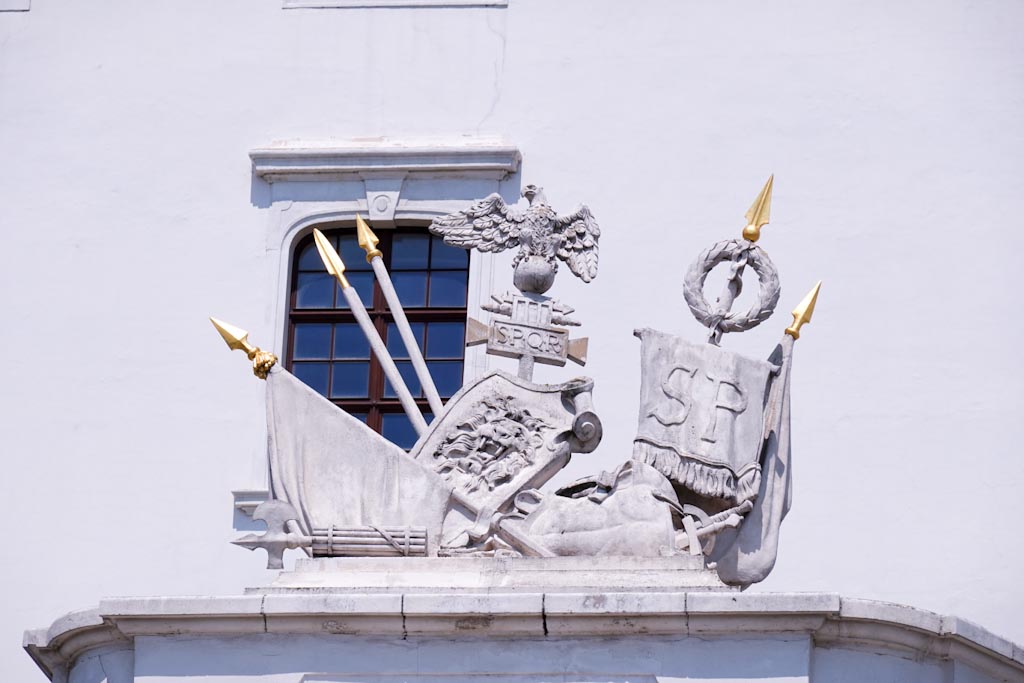
My favourite part of the castle is the trophies of arms, obviously recreated in concrete and painted, but alluring to me nonetheless.



There’s lots of sculptures and statues and amazing buildings around Bratislava. You can certainly spend a lot of time just wandering around, but wandering on a hot day makes me crave ice-cream. After a bit of a hunt we stumble upon what could well be the very best ice-cream ever in the entire world at Schokocafe Maximilian Delikateso in the main square in Bratislava.


The thing that really catches my eye and my imagination is inside Kostol zvestovania Pána (Františkáni), the Church of the Annunciation, a Franciscan church not far off the main square (and therefore not far from the best ice cream shop).
Just about every catholic church has a relic – the mortal remains of a saint, or even something that has been in contact with a saint. In my church when I was growing up, there was a box with a saint’s bone in it (if I remember what my mother told me correctly) which was built into the altar. Relics are supposed to be honoured, not worshipped, and may bring about the odd miracle.
Inside the Church of the Annunciation there is the full-blown teeny little shrivelled body of St Reparatus, a Christian martyr from the 4th century. He died in 353 while having his tongue cut out and his right hand cut off and was buried in Rome until 1769 when they dug up his little body and shipped him off to Bratislava where he lies in a custom-built reliquary (container for relics). The 2,000 year old bones are dressed in tiny little clothes and little pointed shoes and there is a cloth wrapped over the little bony face. Kind of creepy weird, right?

We round off our day in Bratislava with dinner at a brewery and a quiet drink in the very refined library bar at our very refined hotel.